


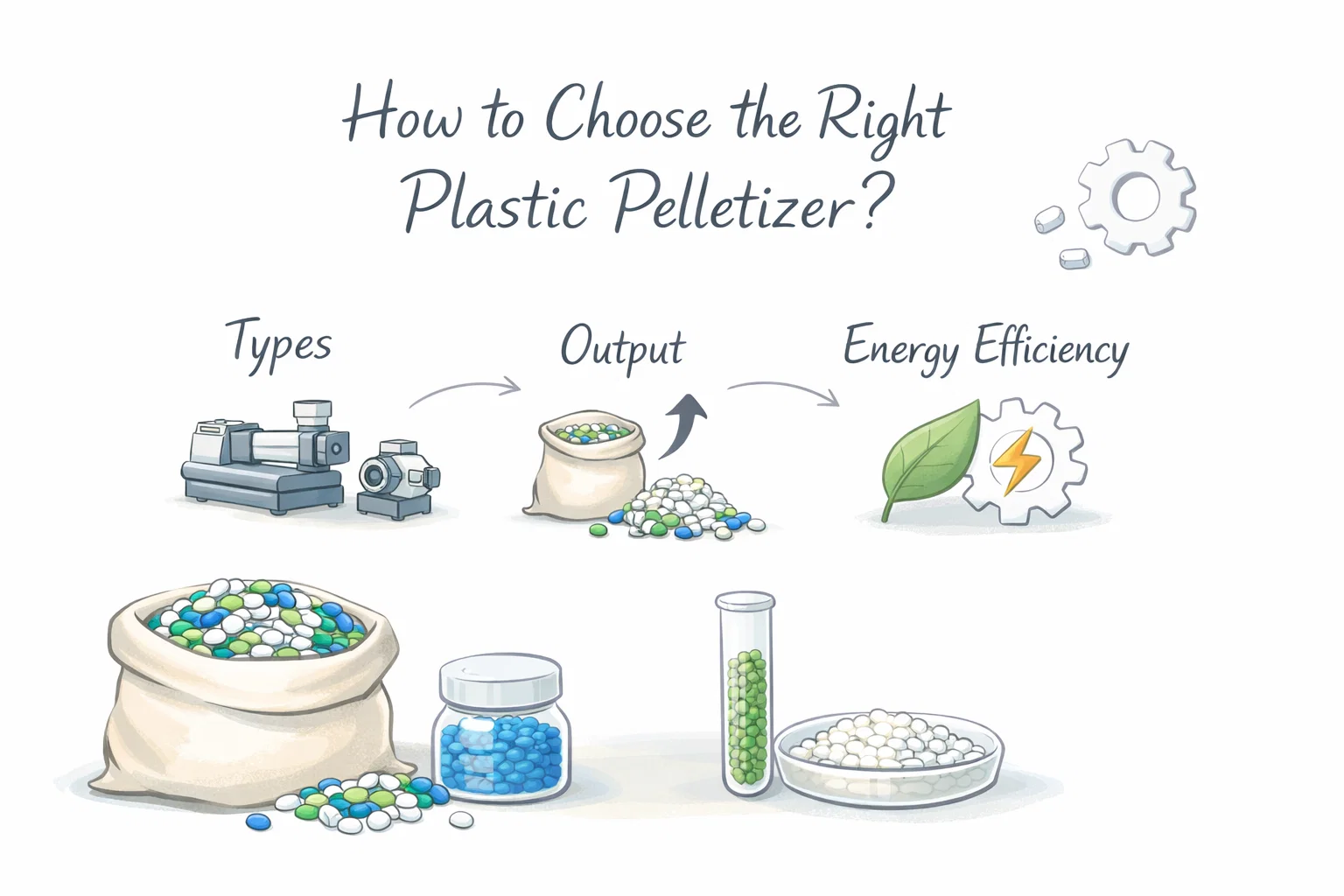
Selecting the wrong plastic pelletizer can stall output, inflate scrap rates, and push operating costs far beyond your initial budget. Whether you are setting up a new recycling facility or upgrading an existing compounding line, this guide gives you the technical framework to match the right pelletizing system to your specific material, throughput, and quality requirements — before you commit to any capital purchase.
What a Plastic Pelletizer Does — and Why the Right Choice Matters
A plastic pelletizer converts molten or semi-molten polymer into small, uniform pellets — the standardized feedstock used across injection molding, blown film extrusion, and compounding applications. The system you select directly affects four business-critical outcomes:
- Pellet quality and consistency — size uniformity, dust generation, moisture content
- Production throughput — whether the pelletizer can match or exceed your extruder’s output
- Energy consumption — measured in kWh per kilogram of processed material
- Long-term maintenance cost and downtime risk — determined by system complexity and parts availability
Poor equipment selection causes strand breakage, inconsistent pellet geometry, excessive fines, or upstream bottlenecks. Matching the pelletizer to your operation from the outset is both an engineering and financial decision.
How a Pelletizer Works (5-Step Snapshot)
- Feed — regrind, washed flakes, or densified film enter the extruder hopper (or cutter-compactor).
- Melt — screw shear and barrel heat produce a controlled melt without degrading the polymer.
- Filter & shape — melt passes filtration and a die (strands or die-face holes).
- Cool — water bath, water-ring, or underwater cooling solidifies the polymer.
- Cut & dry — pellets are cut to size and dried for storage, sale, or molding.
Which Plastics Can a Pelletizer Process?
Most thermoplastic streams can be pelletized when moisture, contamination, and melt temperature are controlled. Use this matrix as a starting point, then validate with trials on your actual feedstock.
| Polymer | Typical sources | Pelletizing notes |
|---|---|---|
| PE (HDPE / LDPE / LLDPE) | Bottles, film, bags, stretch wrap | Film often needs densifying/forced feeding; water-ring common |
| PP | Containers, raffia, woven bags, auto parts | Higher melt point than PE; stable temperature control |
| PS | Packaging, housings, some foam streams | Manage brittleness; avoid overheating |
| PVC | Pipes, profiles, cable (specialized lines) | Strict temperature control; ventilation for fumes; not a casual add-on |
| PET | Bottle flakes, fiber waste | Moisture-sensitive; drying/viscosity control critical |
| ABS, Nylon, TPE | Engineering scrap, compounds | Often strand or underwater; material-specific tooling |
The Three Primary Types of Plastic Pelletizer
Understanding the three main pelletizing methods is the essential first step. Each operates on a different principle and performs best within a defined range of materials and throughputs.
Strand Pelletizer
Molten polymer is extruded through a multi-hole die into long strands, cooled in a water bath, dried, and cut into cylindrical pellets. This is the most widely used method for engineering plastics and general-purpose compounding.
- Best for: PE, PP, ABS, nylon, PC, and filled compounds
- Typical throughput: Up to approximately 2,000 kg/h for large-scale systems
- Key advantage: Lowest initial investment; easy cleaning and rapid material changeovers — ideal for toll compounders running frequent short batches
- Key limitation: Labor-intensive strand threading; brittle or low-viscosity resins prone to strand breakage
Water-Ring Pelletizer (WRP)
Molten polymer is cut directly at the die face by rotating blades. The resulting pellets are thrown outward into a ring of circulating water for immediate cooling, producing a rounded, lenticular shape.
- Best for: High-melt-strength polyolefins — HDPE, LDPE, LLDPE, PP, and polystyrene
- Typical throughput: Up to approximately 1,5000 kg/h
- Key advantage: Compact footprint; well-suited for continuous polyolefin recycling lines with minimal operator intervention
- Key limitation: Not appropriate for sticky, heat-sensitive, or high-MFI materials
Underwater Pelletizer (UWP)
The cutting chamber is completely flooded with process water. Polymer is cut at the die face while fully submerged — surface tension shapes each molten drop into a nearly perfect sphere as it solidifies. This is the highest-performance pelletizing method.
- Best for: Engineering plastics, PET, hot melts, masterbatches, and any high-volume or specialty polymer application
- Typical throughput: Up to 1,500 kg/h or higher for polymerization-scale systems
- Key advantage: Widest material versatility; highest automation; best-in-class pellet uniformity and spherical geometry
- Key limitation: Highest capital cost; requires precise process-water temperature control; more technically demanding maintenance
Six Criteria That Should Drive Your Pelletizer Selection
1. Material Properties and Melt Flow Index (MFI)
The physical and chemical characteristics of your resin are the single most important selection factor. The Melt Flow Index (MFI) — which quantifies how easily a polymer flows when melted — is especially critical for determining cutting method compatibility.
| MFI Range | Recommended System |
|---|---|
| Low MFI (<5 g/10 min) | Strand or underwater pelletizer |
| Medium MFI (5–30 g/10 min) | Water-ring or underwater pelletizer |
| High MFI (>30 g/10 min) | Underwater pelletizer preferred |
Beyond MFI, evaluate:
- Stickiness / elasticity: Tacky or rubber-like materials (TPE, EVA) perform significantly better in water-ring or underwater systems
- Brittleness: Glass-filled or brittle compounds can shatter in strand systems; hot-cut or underwater methods are preferable
- Thermal sensitivity: PVC and certain bioplastics may require air-cooled configurations to prevent degradation
Always consult the material data sheet and run small-scale trials before finalizing a system for a new or complex resin blend.
2. Required Throughput Capacity
Undersizing creates production bottlenecks; oversizing wastes capital and energy. Use these published benchmarks as a starting framework:
- Below 300 kg/h: Strand or air-cooled systems are typically sufficient
- 300–1,000 kg/h: Water-ring pelletizers offer the best cost-to-performance ratio
- Above 1,000 kg/h: Underwater pelletizers are the standard choice for high-volume lines
Critically, ensure the pelletizer’s rated capacity matches the output of your upstream extruder. Even a 10–15% mismatch can cause melt-pressure fluctuations that degrade pellet quality. For reference, Energycle’s pelletizing systems cover a processing range of 300–2,000 kg/h with final pellet sizes adjustable between 3–5 mm to suit different downstream applications.
Also plan for growth. If you expect output to increase 30–50% within three years, choose a system with headroom rather than one sized exactly to your current needs.
3. Pellet Quality Requirements
The end application determines how precise your pellet specifications need to be:
- Medical-grade extrusion and electronics compounding demand dust-free, highly uniform pellets — underwater pelletizing is the industry standard
- General injection molding and blow molding can work with strand or water-ring pellets within acceptable size tolerances
- Masterbatch production often benefits from the micropellet capability of UWP systems, which improves pigment or additive dispersibility in carrier resins
Pellet geometry also affects downstream material handling. Spherical pellets produced by UWPs flow more freely into hoppers and extruder feed throats and achieve higher bulk density than cylindrical strand pellets — an advantage that reduces conveying and feeding inefficiencies.
4. Energy Efficiency
Energy cost is among the largest ongoing expenses in pelletizing. Several technical upgrades deliver measurable reductions in Specific Energy Consumption (SEC — measured in kWh/kg):
- IE3/IE4 classified motors: Per IEC 60034-30-1, IE4-class motors deliver 3–8% lower electricity consumption compared with standard IE1 motors under equivalent load conditions
- Variable Frequency Drives (VFDs): Match motor output to actual processing load in real time, eliminating idle-speed power draw during variable-demand phases
- Barrel insulation and thermal jackets: Reduce external heat radiation from extruder zones, lowering heating energy requirements without affecting melt quality
- PID temperature controllers: Prevent thermal overshoot across barrel zones, cutting energy waste and reducing material degradation that creates scrap
When comparing machines, request the manufacturer’s published SEC figures under defined operating conditions. A lower SEC directly translates to lower production cost per tonne processed.
5. Automation and Process Control
Modern plastic pelletizers integrate PLC-based control systems that monitor and adjust critical parameters in real time: melt temperature, screw speed, cutter pressure, water flow rate, and pellet dimension. Higher automation reduces operator error and improves run-to-run consistency.
Key automation features to evaluate:
- Automated startup/shutdown sequences — minimizes die freeze-off risk in underwater systems
- Integrated screen changers — allows continuous production during filter replacement without line shutdown
- Remote monitoring and data logging — enables predictive maintenance scheduling and production traceability
- Self-stranding capability (wet-strand systems) — reduces manual re-threading labor when strands break
For high-throughput or 24/7 continuous-operation lines, full PLC integration with upstream extrusion and downstream conveying equipment is strongly recommended.
6. Maintenance and Total Cost of Ownership
Purchase price is only the starting point. Total Cost of Ownership (TCO) over a 5-year operating horizon should include:
- Cutting components: Knives and die plates are recurring consumables — underwater and water-ring systems wear blades more frequently than strand systems
- Process-water management: UWP and WRP systems require ongoing filtration, temperature control, and water treatment infrastructure
- Downtime cost: Systems with easier blade access and die cleaning reduce unplanned production stops
- Operator skill requirements: More automated systems demand fewer operator-hours but require higher technical competency for troubleshooting
A useful rule of thumb: if a higher-specification system carries a 25–35% higher purchase price but delivers meaningfully lower energy consumption and reduced labor hours, the 5-year TCO will frequently favor the premium option. Build this analysis before making any final decision.
Plastic Pelletizer Type Comparison
| Factor | Strand Pelletizer | Water-Ring Pelletizer | Underwater Pelletizer |
|---|---|---|---|
| Throughput | Up to ~2,000 kg/h | Up to ~1,500 kg/h | Up to ~1,500 kg/h |
| Material Range | Wide | Polyolefins mainly | Widest |
| Pellet Shape | Cylindrical | Rounded/flat | Spherical |
| Pellet Uniformity | Good | Good | Excellent |
| Initial Cost | Low | Medium | High |
| Automation Level | Low–Medium | Medium | High |
| Maintenance Complexity | Simple | Moderate | Technical |
| Footprint | Large | Compact | Medium |
| Primary Use Case | Compounding, engineering plastics | Polyolefin recycling | High-volume & specialty polymers |
Four Common Pelletizer Selection Mistakes
- Choosing by price alone. A lower-cost strand system will underperform with high-MFI or sticky materials, resulting in frequent downtime and elevated scrap rates that erode any initial savings.
- Ignoring utility requirements. Underwater systems require a reliable process-water circuit — confirm your facility can deliver the required water volume, filtration capacity, and temperature control before specifying a UWP.
- Undersizing for current capacity only. If production volume is projected to grow significantly within 3 years, a system with no headroom becomes a constraint before its capital cost is amortized.
- Skipping material trials. New resin blends, regrind streams with variable contamination, or compounds with additives can behave unpredictably — always validate with trial runs before full-line commitment.
Key Takeaways and Next Step
Choosing the right plastic pelletizer comes down to five core factors working together:
- Material properties — MFI, stickiness, brittleness, and thermal sensitivity determine which cutting method is viable
- Required throughput — the <300 / 300–1,000 / >1,000 kg/h benchmark guides system type selection
- Pellet quality requirements — downstream application tolerances dictate pellet geometry and uniformity standards
- Energy efficiency — IE3/IE4 motors, VFDs, and thermal management reduce long-term SEC
- Total Cost of Ownership — a 5-year horizon provides a more accurate basis for investment decisions than purchase price alone
Energycle engineers plastic pelletizing systems for PP, PE, PET, and mixed polyolefin streams across a 300–2,000 kg/h processing range. For a deeper breakdown of cutting-method differences, see our guide to plastic pelletizer types.
Request a material assessment to identify the right pelletizer configuration for your specific resin, contamination level, and production targets — before specifying any equipment.
