


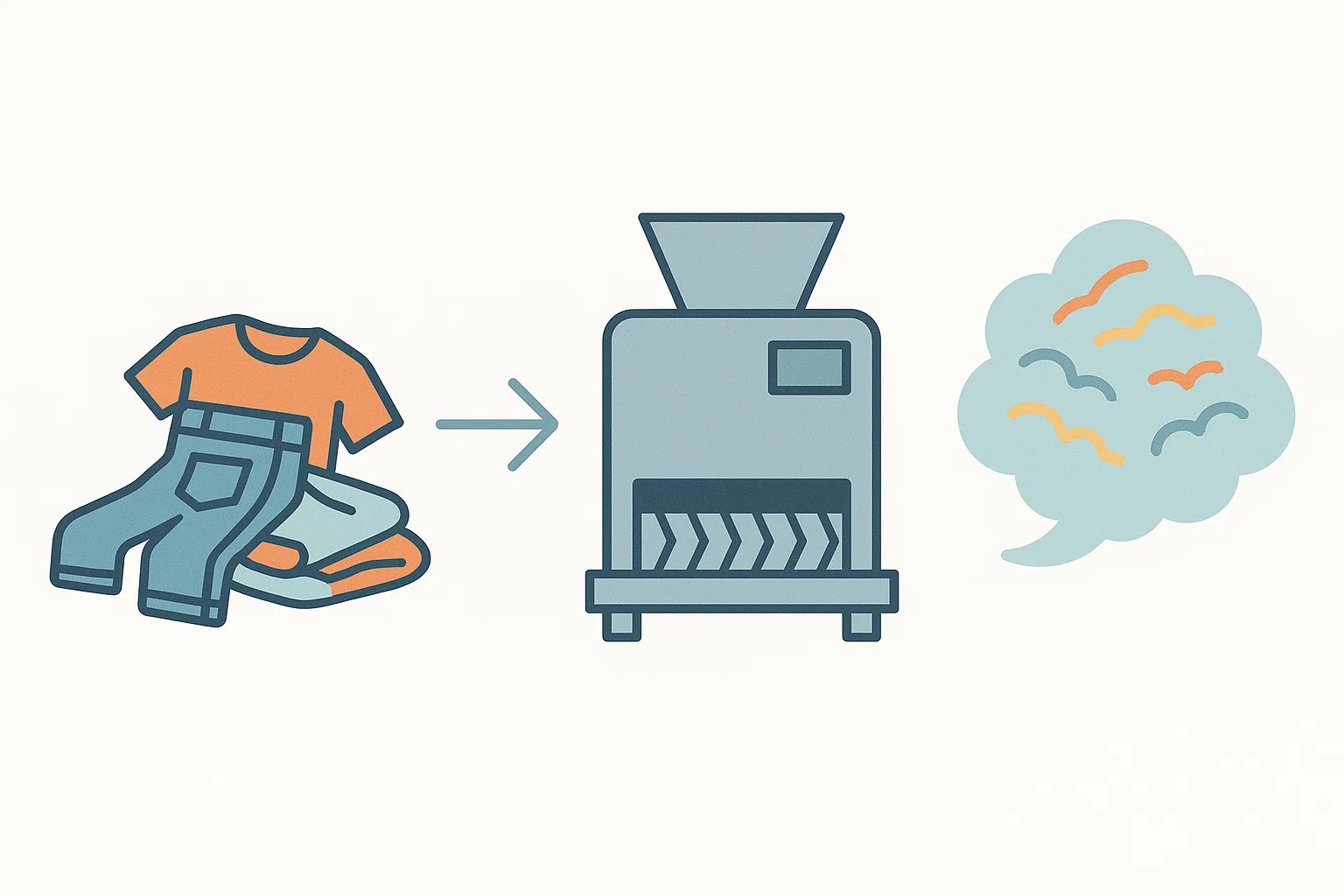
Textile waste recycling applications differ by material construction and the intended output. Cotton cutting waste can be opened for recovered fiber, mixed garments may be reduced for insulation or fuel, and carpets often require staged size reduction and metal removal. The correct process starts with the application—not a generic shredder specification.
For a complete explanation of machine design and working principle, read our textile shredder working guide. Buyers comparing industrial equipment can review the textile and fiber waste shredder product page.
Textile Waste Streams and Their Best Recycling Routes
Not all textile waste is the same problem. A bale of clean cotton cutting waste and a bale of end-of-life carpet share almost nothing except the word “textile” — they need different machines, different preparation, and produce different products. The table below maps the common waste streams to their realistic recycling routes.
| Waste Stream | Preparation Challenge | Typical Output / Application |
|---|---|---|
| Clean cotton cutting waste | Low bulk density and long fibers | Fiber opening, wiping material, stuffing |
| Mixed clothing and uniforms | Zippers, buttons, elastic, blended fibers | Insulation, felt, acoustic panels, RDF |
| Denim and heavy fabric | Dense seams and multiple layers | Recovered fiber, nonwoven products |
| Carpet and upholstery | Backing, adhesives, wire, and high wear | Granulated feed, fuel, separated polymer/fiber |
| Nonwoven production scrap | Elastic, springy sheets that wrap around rotors | Reprocessing feed or densified material |
| Rope, yarn, and fishing net | Extreme wrapping risk | Controlled-size feed for washing or pelletizing |
Application 1: Garment Factory Offcuts
Pre-consumer cutting waste is usually the cleanest textile stream — known fiber content, no consumer contamination, consistent supply from the factory floor. The main challenge is feeding light, irregular pieces without bridging in the hopper. A low-speed cutter or shredder can prepare material for opening, carding, densification, or downstream nonwoven production.
- Separate cotton, polyester, nylon, and blended lots when possible — mixed lots downgrade the recovered fiber value.
- Keep oil, paper patterns, plastic film, and floor sweepings out of the feed; one contaminated bale can spoil a shift of output.
- Preserve fiber length when recovered fiber is the target; smaller output is not always better — over-shredding destroys the fiber value you are trying to recover.
Because the material is clean and consistent, garment offcuts are the ideal entry point for fiber-to-fiber recycling: opened cotton fiber can go back into yarn spinning, and polyester offcuts can feed nonwoven lines directly.
Application 2: Post-Consumer Clothing
Used garments vary in fiber, moisture, construction, and contamination — every bale is a surprise. Sorting by composition (cotton, polyester, wool, blends) and removing metal accessories improves downstream quality and reduces blade damage. This front-end sorting is labor-intensive but decides the economics of the whole operation.
Where fiber-to-fiber recycling is not practical — heavily blended, stained, or worn garments — shredded textiles enter lower-grade applications: insulation batts, furniture padding, acoustic panels, molded automotive composites, or prepared fuel. These outlets accept mixed fibers and pay less, but they keep the material out of landfill at scale.
Application 3: Carpet, Upholstery, and Automotive Textile
Carpet and upholstery combine face fiber, backing, adhesive, foam, and sometimes wire — the most mechanically demanding textile stream. A staged line is normally more reliable than one aggressive pass: pre-cut bulky pieces to manageable size, remove metal with detection and separation, shred to a controlled size, then separate or granulate according to the recovery target.
The economics hinge on separation. Nylon face fiber recovered cleanly has real value; the same fiber contaminated with backing adhesive and foam does not. Plants that invest in the separation stage — air classification, density separation — capture the margin that single-pass shredding leaves behind.
Application 4: Nonwoven, Yarn, Rope, and Fiber Waste
Long flexible material can wrap around high-speed shafts — this is the failure mode that destroys ordinary shredders in textile service. Low-speed torque, anti-wrapping geometry, controlled feeding, and reversible overload protection are more important than maximum rotor speed. For ropes and nets, pre-cutting length and metal detection should be defined during trials.
Nonwoven production scrap is springy and elastic; it needs positive feeding that forces the material into the cut rather than letting it bounce. Fishing nets add salt, sand, and metal sinkers to the wrapping problem — wash and metal-detect before shredding, not after.
Choosing the Right Shredder for Textiles
Textile shredders differ from plastic shredders in three ways: lower rotor speed with higher torque (to cut without wrapping), cutting chamber geometry that resists material buildup, and feeding systems designed for light, bulky, bridging-prone material. A plastic granulator run at full speed on rope waste will wrap solid in minutes — the machine must be built for the material.
Size the shredder for your toughest material and your target output size together. Fine output needs more cutting work and smaller screens, which reduces throughput; agree the output specification with your downstream process before selecting the machine, not after.
Process Layout by Final Product
The end product dictates the line. Work backward from what you need to sell or use, and let that define every upstream choice.
| Final Product | Typical Process | Key Control |
|---|---|---|
| Recovered fiber | Sorting → cutting → opening → cleaning | Fiber length and contamination |
| Insulation or felt feed | Sorting → accessory removal → shredding → blending | Uniform size and composition |
| Plastic pellet feed | Sorting → shredding → washing/drying → densifying/pelletizing | Polymer purity and moisture |
| RDF/SRF | Sorting → metal removal → primary/secondary shredding | Calorific value, chlorine, and output size |
Material Trial Checklist
Never finalize a textile recycling line on paper alone. Run a representative trial with your actual waste and check every item below — the trial is where expensive surprises are cheapest to discover.
- Representative material composition and moisture — test the worst bale, not the best
- Maximum piece, roll, bale, rope, or carpet dimensions the line must accept
- Metal accessories, wire, buttons, zippers, and hard contaminants
- Required output size and acceptable fines percentage
- Target downstream process and required fiber length
- Hourly throughput, shifts, and available operators
- Wrapping behavior on long flexible material at sustained throughput
- Dust generation and extraction requirements
A successful textile recycling line is built around the waste stream and end use. Run a representative material trial before finalizing rotor, screen, feeding, and separation configuration.
Frequently Asked Questions
What is the best way to recycle textile waste?
It depends on the material and the target product. Clean cotton offcuts can be opened back into fiber; mixed post-consumer clothing suits insulation, felt, or molded composites; carpets need staged shredding with metal removal. The right route starts with the waste stream and the end use — not with a generic machine specification.
Can a textile shredder handle ropes and fishing nets?
Yes, but only with the right configuration. Long flexible material wraps around high-speed shafts, so the machine needs low-speed high-torque drive, anti-wrapping geometry, controlled feeding, and reversible overload protection. Pre-cutting length and metal detection should be defined during material trials.
What is the difference between shredding and fiber opening?
Shredding cuts material into smaller pieces; fiber opening pulls woven or knitted fabric back apart into individual fibers. Opening preserves fiber length and is used when recovered fiber is the target product — for example, spinning recycled yarn or making nonwovens.
How do I choose a shredder for textile waste?
Match the machine to your toughest material: carpet and upholstery need staged size reduction with metal removal; ropes and nets need anti-wrapping design; garment offcuts need gentle feeding that preserves fiber length. Our textile shredder guide explains the design differences, and the textile shredder product page covers the available configurations.
What can recycled textile fiber be used for?
Recovered fiber goes into new yarn (fiber-to-fiber), nonwoven products, insulation, acoustic panels, wiping cloths, and stuffing. Lower-grade shredded textiles become molded composites, carpet underlay, or refuse-derived fuel (RDF) for energy recovery.
Do I need to remove zippers and buttons before shredding?
Yes. Metal accessories damage blades and contaminate the output. Sort them out before shredding, and use metal detection on the infeed for carpet and post-consumer streams where accessories are easy to miss.
Should I run a material trial before buying?
Absolutely. Textile waste varies enormously in construction, contamination, and moisture. A representative trial defines the rotor, screen, feeding, and separation configuration — and reveals problems (wrapping, bridging, metal damage) before they become expensive surprises. See the trial checklist below.
Planning a textile recycling line? Browse our textile shredder range or contact our engineering team with your waste stream and target product for a tailored line configuration.
