


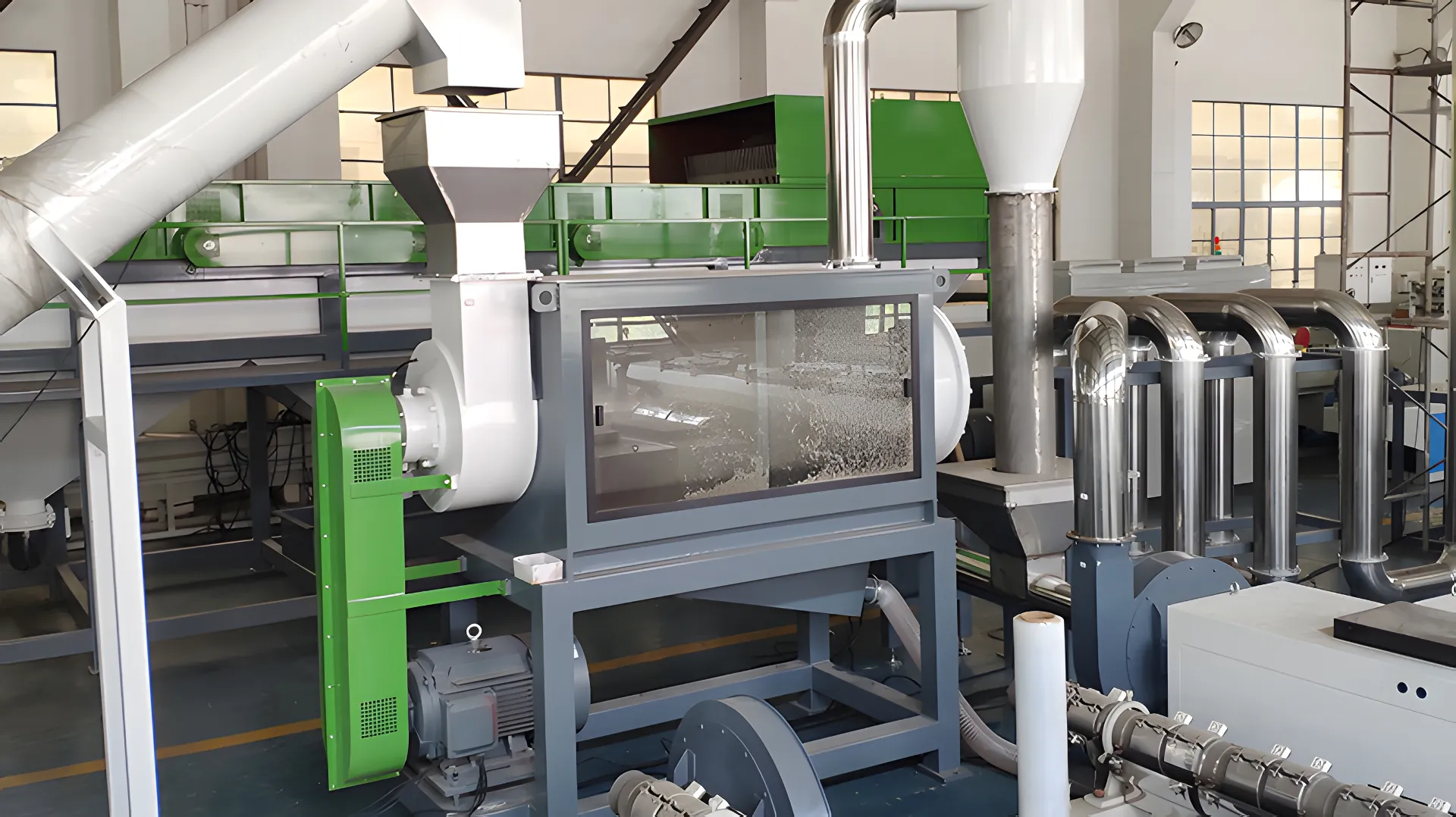
After a wash tank or friction washer, plastic flakes and film come out soaking wet. That leftover water is more than an inconvenience: it slows down every downstream step, wastes energy in drying, and can ruin pellet quality in the extruder. For polyethylene (PE) recyclers, the first line of defense against that moisture is mechanical dewatering — and the workhorse of the process is the centrifugal dryer.
A centrifugal dryer dewatering machine spins washed plastic at high speed so centrifugal force throws the free water out through a perforated screen. It is simple, fast, and cheap to run — which is why almost every PE film washing line in operation today starts its drying stage with one.
Why Moisture Is the Enemy in Plastic Washing Lines
Washed PE film and flakes typically carry 10–30% surface moisture by weight after the rinse stage. That water has to go somewhere before pelletizing, and leaving it in place causes three problems:
- Energy waste: evaporating water thermally costs roughly 0.6–0.7 kWh per kilogram. Removing it mechanically first cuts the load on thermal dryers dramatically.
- Pellet quality: excess moisture in the extruder turns to steam, causing bubbles, voids, and splay in the finished pellets — a direct hit on sale price.
- Throughput and handling: wet film clumps, sticks to conveyors, and bridges in hoppers. Drier material flows through the line predictably.
This is why drying is not a single machine but a staged process: mechanical dewatering first, then thermal finishing only for the last few percent of moisture.
How a Centrifugal Dryer Removes Water from Wet Plastic
The working principle is straightforward. Wet plastic enters a vertical drum lined with a perforated screen. The drum spins at 900–1,500 RPM, and centrifugal force — hundreds of times stronger than gravity — flings the water outward through the screen openings while the plastic stays inside. A screw or paddle mechanism moves the material upward through the drum so it exits drier at the top while water drains away at the bottom.
The key physics point: centrifugal drying only removes surface (free) water, not water absorbed into the plastic. That is fine for PE, PP, and PET, which absorb almost no water. For materials like nylon that absorb moisture internally, thermal drying is still required afterward.
In one pass, a well-matched centrifugal dryer typically drops moisture from 15–25% down to 1–5%, depending on the material form. Film is the hardest case because it traps water between folded layers; rigid flakes and pellets are easier to dewater.
Key Components of a Plastic Dewatering Centrifuge
Understanding what is inside the machine helps you evaluate build quality when comparing quotes:
- Perforated drum/screen: the heart of the machine. Screen hole size and open area determine both dewatering efficiency and how much fine material is lost with the water. Wear-resistant stainless steel is standard for abrasive washed film.
- Rotor and paddles: lift and agitate the material so every particle gets spun against the screen. Paddle design matters most for tangling-prone film.
- Drive motor and bearings: sized for continuous duty at high RPM. Bearing quality is the single biggest factor in long-term reliability.
- Feed and discharge chutes: must handle wet, sticky material without bridging. Film lines usually need an anti-tangle feed design.
- Water collection housing: catches the expelled water and drains it to the plant’s water treatment or recycling system.
Centrifugal vs Thermal Drying: Choosing the Right Approach
Centrifugal and thermal drying are not competitors — they are stages. But knowing where each one belongs saves real money:
- Centrifugal drying removes free water mechanically at roughly 0.01–0.03 kWh per kilogram — an order of magnitude cheaper than evaporation. It handles the bulk of the water.
- Thermal drying (hot air or pipe dryers) evaporates the remaining 1–3% of moisture down to the sub-1% levels pelletizing demands. A thermal dryer is the right finishing step, not the first one.
Running thermal drying on soaking-wet material is the most expensive mistake in a washing line: you pay evaporation energy for water a centrifuge could have removed for pennies. For a detailed head-to-head, see our comparison of centrifugal dryers vs air drying for energy efficiency.
Where Centrifugal Dryers Fit in a PE Film Washing Line
In a typical PE film washing line, the centrifugal dryer sits right after the final rinse or friction washer:
- Shredder / crusher → size reduction
- Wash tanks + friction washer → cleaning
- Centrifugal dryer → mechanical dewatering (25% → 3–5% moisture)
- Squeeze dryer (optional, film only) → further mechanical dewatering
- Thermal dryer → final drying to <1%
- Pelletizer → granulation
For rigid flakes (HDPE bottles, crates), the centrifugal dryer is often the only mechanical dewatering stage needed before thermal drying. For film, many lines add a squeeze dryer after the centrifuge because film’s folded structure holds water more stubbornly. Our detailed comparison of dewatering technologies for PE film washing lines breaks down when each combination makes sense.
Typical Moisture Targets After Centrifugal Dewatering
What counts as “dry enough” depends on the next step in your process:
- After centrifugal dryer alone: 1–5% residual moisture, depending on material and feed rate. Good enough for storage and transport, or for feeding a thermal dryer.
- Before a pelletizing extruder: below 1–2% is the common target; vented extruders tolerate up to ~2%, while strand pelletizing generally wants under 1%.
- For direct sale as washed flake: buyers typically specify <2–3% moisture, since they pay by weight.
If your centrifuge is leaving more than 5% moisture on film, the usual culprits are overfeeding (material moves through too fast to get spun dry), a worn screen with enlarged holes, or feed that is too dirty — fines and sludge clog the perforations. Each is fixable without replacing the machine.
Matching Capacity and Power to Your Output
Centrifugal dryers are rated by throughput (kg/h) and motor power, but the rating only means something at a stated feed moisture and material type. A dryer rated 1,000 kg/h on rigid PET flakes may only handle 500–700 kg/h on wet PE film, because film holds more water and moves through the drum differently.
When sizing, give your supplier three numbers: your line’s actual throughput, the feed moisture coming into the dryer, and the material mix (film vs rigid, and how dirty it is). A supplier who quotes without asking for these is guessing. Also check the installed motor power relative to capacity — undersized drives are the most common cause of chronic underperformance, and they cannot be fixed by running the machine longer.
How to Choose a Centrifugal Dryer: RFQ Checklist
Use this checklist when requesting quotes so every supplier prices the same scope:
- Material and form: PE film, HDPE flakes, PET flakes, or a mix — plus typical contamination level.
- Throughput: kg/h at your real operating hours, not nameplate wishful thinking.
- Target moisture: what residual moisture you need at the dryer discharge.
- Screen spec: hole diameter, open area, and material (stainless grade) — this determines both dryness and fines loss.
- Motor power and RPM: and whether the drive is inverter-controlled for different materials.
- Wear parts list with prices: screens, paddles, bearings — ask for a 2-year spare parts price list up front.
- Reference installations: same material, similar capacity, running for at least a year.
And keep the full system in mind: a dryer is one stage of a line, so its price only makes sense in context. Our guide to plastic recycling washing line cost explains what drives the total investment.
See the Dewatering Machine and Request a Quote
If you are sizing a new washing line or replacing an underperforming dryer, start with the machine itself: see the centrifugal dryer dewatering machine specifications, capacity options, and layout drawings — then send your material details and throughput for a matched quote.
Frequently Asked Questions
What moisture level can a centrifugal dryer achieve on PE film?
A well-matched unit typically brings PE film from 15–25% feed moisture down to 3–5% in a single pass. Getting below 1% requires a thermal finishing dryer downstream.
Can a centrifugal dryer handle PET flakes as well as PE?
Yes. Rigid PET and HDPE flakes are actually easier to dewater than film because they don’t fold and trap water. Many recyclers run the same dryer for both, adjusting feed rate and RPM.
How does a centrifugal dryer differ from a thermal dryer?
A centrifugal dryer removes free surface water mechanically with spinning force, using very little energy. A thermal dryer evaporates remaining moisture with heat. They work in sequence: centrifugal first for the bulk water, thermal for the final 1–3%.
What capacity range do industrial centrifugal dryers cover?
Common models range from about 300 kg/h for small lines up to 2,000 kg/h or more for large film washing plants. Always confirm the rating is stated for your specific material — film ratings run lower than rigid flake ratings on the same machine.
Does centrifugal drying damage soft film?
No. The forces involved separate water from the film without tearing it; film comes out as damp clumps, not shredded pieces. Damage usually comes from an oversized screen hole or excessive RPM for the material, both avoidable with correct setup.
Is a squeeze dryer better than a centrifugal dryer for film?
They serve different stages. A centrifugal dryer handles higher throughputs and wetter feed; a squeeze dryer wrings film further down toward 3% but at lower capacity and higher wear cost. Most large film lines use both in sequence.
What maintenance does a centrifugal dryer need?
Daily: check for abnormal vibration and clear the water drain. Weekly: inspect screen perforations for clogging or wear. Monthly: check belt tension, bearing temperature, and paddle wear. See our guide on how to extend the life of your centrifugal dryer for the full routine.

Comments are closed.